
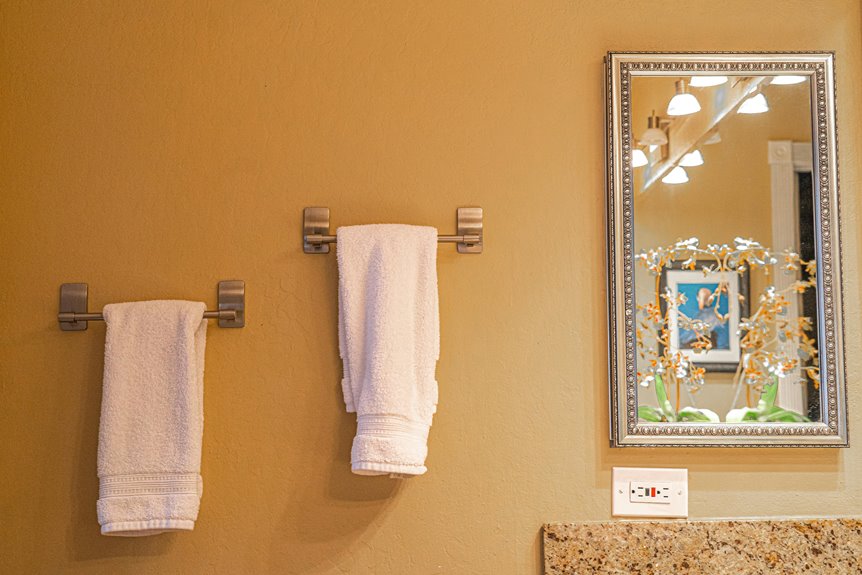
I’ve updated my plain bathroom towels into spa-like pieces using straightforward methods you can try today. You can glue or sew ribbons along edges, create textured loop and pleated trims, and craft fabric rosettes for accent details. The key is choosing what works for you—fabric glue is quick and easy, while sewing provides stronger durability. Then display your decorated towels on hooks, rails, or rolled in baskets to showcase your work. Keep scrolling to discover exactly how each technique works.
Get Your Towels and Supplies Ready
Before you start decorating, here’s what you’ll want to do first: wash and dry your towels and any fabric you’re planning to use. It prevents puckering later.
Once everything’s dry, gather your supplies. You’ll need ribbon or fabric, matching thread, scissors, and a measuring tape. Decide now whether you’re sewing or using fabric glue for your towel embellishment. Fabric glue works well for quick projects since it’s laundry-compatible and less intimidating.
Set up a clean, dry workspace. Prewash all materials so they stick properly. Finally, plan how you’re folding or finishing those edges—whether wrapping the ribbon around or hemming underneath. This prevents unraveling and gives you a polished look.
Decorate Towels With Sewn or Glued Ribbon and Fabric
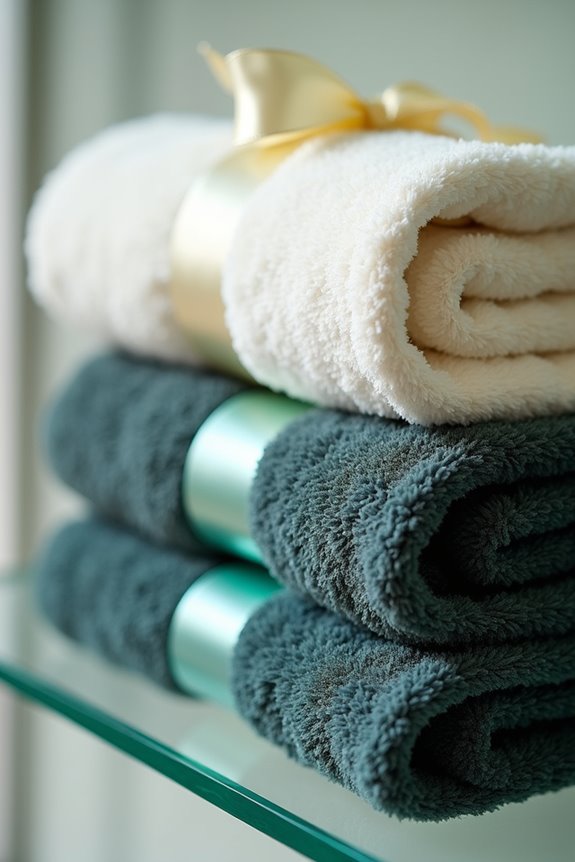
I’m going to show you two straightforward ways to add ribbon or fabric to your towels—sewing or gluing—and how to finish those edges so everything looks polished. You’ll pick whichever method feels right for you: fabric glue if you want to skip the sewing machine, or needle and thread if you’re comfortable stitching. Either way, the key is making sure those edges don’t fray and your decorative trim stays put through countless washes.
Ribbon Attachment Methods
When you’re ready to dress up your towels with ribbon and fabric, you’ve got two straightforward ways to make it stick: fabric glue or needle and thread.
Fabric glue works well for quick projects. It’s suitable for non-sewing embellishments and decorative trim work. You simply apply the glue along your towel’s edge, press the ribbon down, and you’re done. No sewing skills needed.
If you prefer sewing attachments, grab your machine or needle and hand-stitch your ribbons and fabric directly onto the towel. This method creates stronger, longer-lasting results.
When finishing ribbon ends, fold them under neatly before securing everything in place. This gives your towel a polished, professional appearance.
Both ribbon attachment methods work well—choose whichever fits your style and comfort level.
Finishing Edge Techniques
The way you finish your ribbon or fabric edges affects the quality between a towel that looks handmade and one that looks professionally done. I’ve learned that choosing the right ribbon finish improves your project. With a hem finish, I fold the end under the top ribbon, align it with the front edge, press carefully, then sew vertically to stop unraveling. For something different, I try the wrap-around method—wrapping fabric around to the back, folding the raw end under, pressing, and sewing for a clean cross-edge look. When I’m worried about laundering or want an easier approach, fabric glue works well for non-sewing embellishments. Either way, proper edge finishing prevents fraying and creates that polished look we’re all after.
Finish Ribbon Ends: Clean Hem and Wrap Techniques
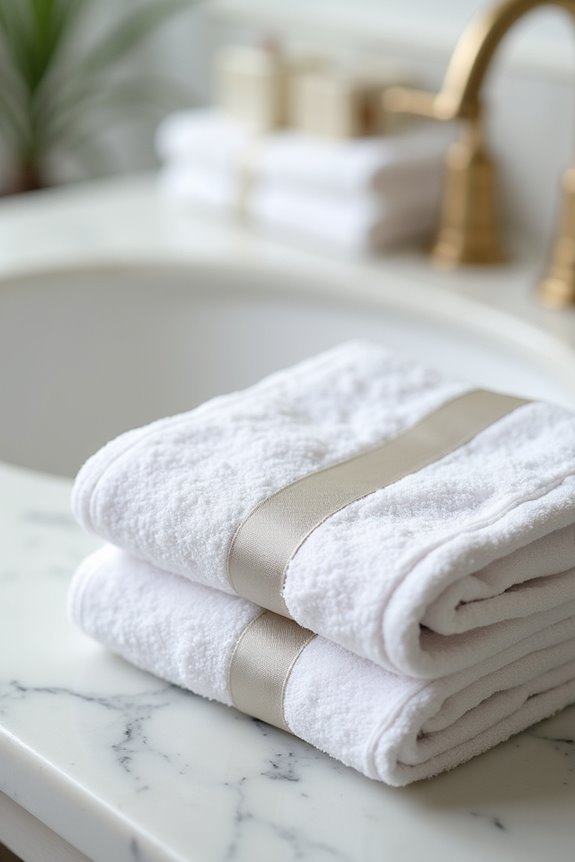
How do you keep those pretty ribbon edges from fraying and unraveling after you’ve sewn them onto your towel? I’ve found three effective methods that work well.
The hem finish is my preferred choice. I fold the ribbon end under the top edge, align it perfectly with the front, press it flat, then sew vertically to lock everything down. It’s clean and secure.
The hem finish is my preferred choice—fold the ribbon end under, align it perfectly, press flat, then sew vertically to lock everything down.
The wrap finish takes a bit more patience. I wrap fabric around to the back, fold that raw end under, press, and sew. The result is a continuous, seamless edge that looks professional.
For my decorative towels, I sometimes use one long ribbon piece wrapping front and back—no visible seams at all.
Each towel edges technique prevents unraveling differently. Choose based on your design vision and how polished you want your creation to look.
Layer Texture With Loop and Pleated Trim Designs
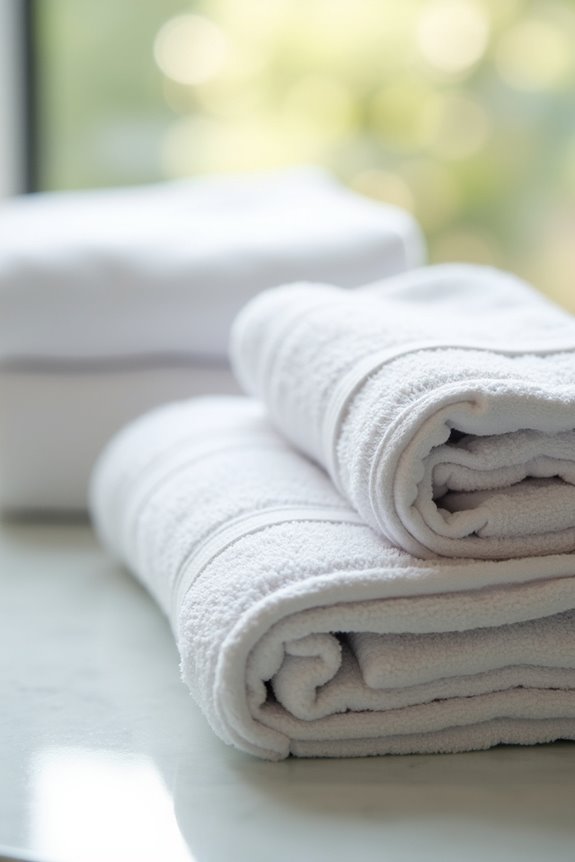
I’ve found that loop and pleated trims work well when you’re ready to develop your towel design beyond the basics. With loop trim, I fold ribbon into small, even loops and pin them onto a backing before sewing them down—it creates a tactile pattern that feels luxurious under your fingers. For pleated ribbons, I cut a length, create evenly spaced pleats, and sew along the top edge, then attach it to the towel for that structured, dimensional look that gives a basic towel a more refined appearance.
Loop Trim Attachment Methods
Once you’re ready to add serious texture and dimension to your towels, loop trim attachments are an effective technique. I’ve found that folding ribbon pieces in half creates perfect loops for this method. Pin each loop onto your base ribbon, spacing them evenly—this requires attention to detail.
Now comes the securing part. I attach the top edge of each loop with a short vertical stitch or a dab of fabric glue. Keep those loops laying flat against your towel surface for a polished look. The best part? You can alternate your loop trim with pleated trim along the same line for added visual interest. This combination creates distinctive towels suitable for display in your bathroom.
Pleated Ribbon Styling Techniques
Why settle for flat ribbon when you can create actual dimension that’ll make your towels look professionally finished? I’ve discovered that layering pleated ribbon with flat bands creates distinctive towel embellishment. Here’s what I do: I cut ribbon to length, fold it into uniform pleats, then sew along the top edge. Visual depth develops when I alternate this textured ribbon with smooth fabric strips.
For extra polish, I add small decorative beads along the seam. They catch light beautifully. I secure everything with a clean hem finish to prevent fraying. Combining pleated ribbon with looped accents creates an upscale appearance. This decorative trim technique improves your bathroom’s style at a reasonable cost.
Craft Statement Pieces: Fabric Rosettes and Button Tassels
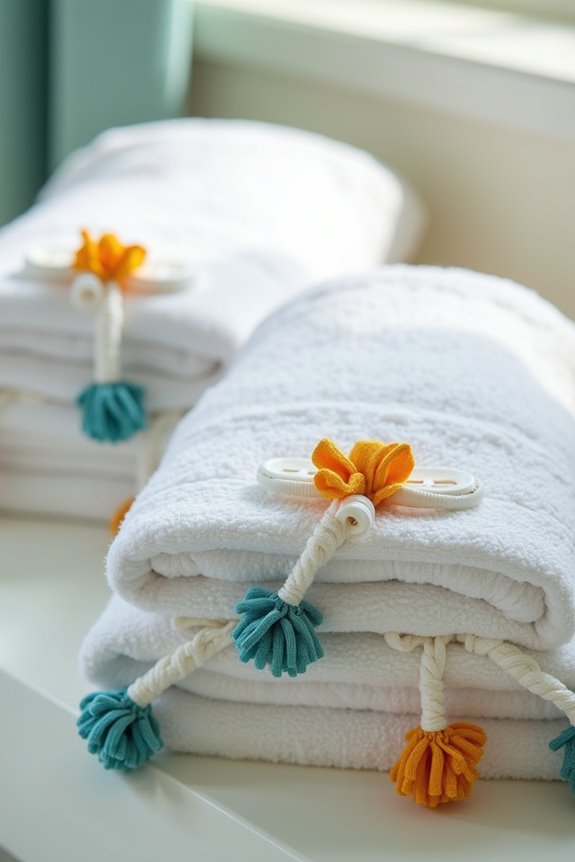
How do you turn a plain towel into something you’ll reach for with satisfaction? Fabric rosettes and decorative tassels do exactly that. I create these DIY embellishments by cutting three-inch fabric circles and gathering the edges with running stitches. A button or bead centers each rosette perfectly.
| Material | Purpose | Result |
|---|---|---|
| Fabric circles | Base structure | Gathered flower shape |
| Buttons/beads | Center accent | Polished focal point |
| Coordinating ribbon | Pairing element | Cohesive design |
I attach my fabric rosettes to bathroom towels using fabric glue for quick results or needle and thread for durability. Trimming excess fabric at the back keeps everything neat. Larger rosettes become striking accents, while smaller ones add subtle charm. This personal touch makes ordinary towels into pieces you genuinely love displaying.
Display in Baskets: Rolling and Nesting for Easy Access
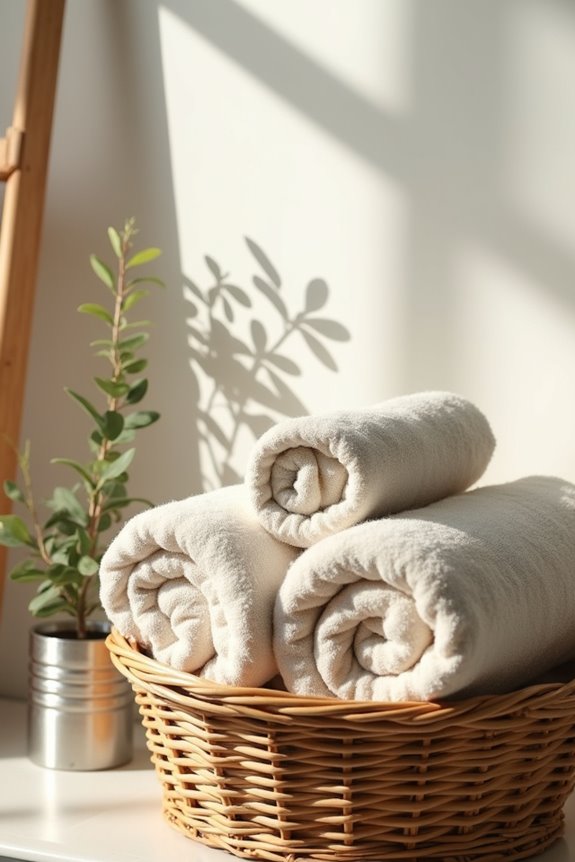
Now that you’ve created those gorgeous fabric rosettes to dress up your towels, you’ll want to display them somewhere that shows them off while keeping everything organized.
Display your fabric rosette-adorned towels in a beautiful basket that showcases them while keeping everything organized and accessible.
I fold my towels lengthwise into thirds, then roll them tightly end-to-end. This method maximizes space and looks polished. I nestle them upright in a seagrass basket with the ends facing up—it’s satisfying to grab what you need without disrupting the whole stack.
The best part? Mixing colors and patterns. I layer different hues to create visual interest in the display. My rattan basket brings warmth to my bathroom while maintaining that coastal vibe I’m after.
I keep an extra set nearby for quick replenishment. Everything stays organized and accessible.
Hang and Drape on Hooks, Rails, and Open Shelves
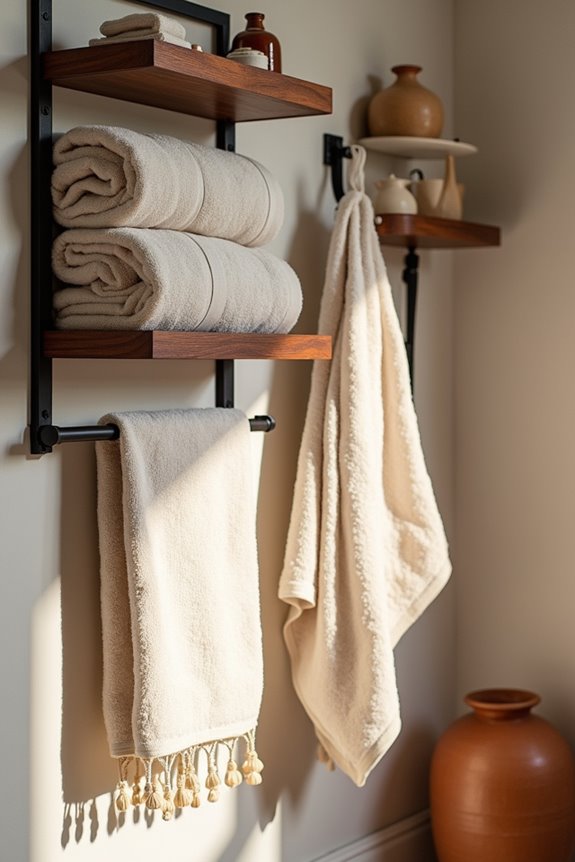
Vertical storage makes even the tiniest bathroom work as a display area. Decorative hooks, ladders, and rails serve both function and design purposes.
I hang my towels using classic folds that cascade down rails, creating a spa-like feeling. Decorative ladders let me layer towels on multiple tiers, making everything accessible while maintaining organization. I alternate solid and patterned towels for visual variety.
What worked in my space: I drape leather ties or ribbons over folded towels, adding a curated quality to the room. Pairing complementary colors and textures—like solid linen with waffle-weave towels—strengthens the overall aesthetic.
These details shift towels from everyday necessities into thoughtful décor that shows who you are.